Showing posts with label fruit. Show all posts

Thursday, June 25, 2020

APPLEWOOD – WHY WE DON’T USE IT! – HERE’S WHY

We don't use or sell Applewood! Too many potential health risks
We don’t use or sell Applewood! Too many potential health risks

Why we Don’t Use or Sell Applewood– Those of you living outside of New York State may be surprised to learn that we are the number two state for apple production behind Washington state.

However, we do rank number one for the greatest number of varieties of apples.  Annually, our state produces nearly 30 million bushels of apples.

With an abundance of apple trees, the assumption would be that our number one hardwood offering must be apple.  However, you would be wrong.

Applewood Abundance Comes at a Cost


Just because apple wood is abundant in our state doesn’t mean it should automatically be sold as a cooking wood.  This is without question, a favorite fruit.  When something is at high demand it is protected in order to assure the supply for that demand.  For this reason, growers of apples put their priority into preserving the fruit production.

Keep in mind, an apple tree may not start producing fruit for the first 8-10 years but it can produce for 50 or more years.  In fact, with careful and frequent pruning, these trees do remain in the orchard bearing fruit if they don’t become infested with a disease or pest.

Good Agricultural Practices


Around the year 2001, the New York apple industry began working on a strategic plan in conjunction with Cornell University to develop what they referred to as an integrated fruit production program. 
The purpose of the program was to ensure apples were produced using environmentally friendly processes to include eco-friendly insect, mite, disease, vertebrate and weed pest management.  In other words, this was meant to use more “friendly” pesticide applications and methods.  What didn’t change is the that chemicals were still being used.

The USDA has done extensive study on pesticides and their life on agricultural products (USDA Pesticide Data Program). As a result of the studies, here is a list of the common pesticides found to be present on apples in what is termed residual form.

USDA Findings:

Diphenylamine (DPA) 82.8%
Thiabendazole 81.0%
Pyrimethanil 75.2%
Chlorantraniliprole 41.2%
Acetamiprid 28.7%
Imidacloprid 20.2%
Carbendazim (MBC) 17.3%
Tetrahydrophthalimide                16.7%
Methoxyfenozide 15.9%
Fludioxonil 13.4%
Thiacloprid 12.7%
Boscalid 12.7%
Pyraclostrobin 11.8%
Phosmet 9.6%
Azinphos methyl 9.2%
Fenpyroximate 8.5%
Endosulfan II 8.1%
Myclobutanil 8.1%
Diazinon 6.5%
Trifloxystrobin 5.8%
Spinetoram 5.0%
Endosulfan I 4.3%
Etoxazole 3.3%
Pendimethalin 3.3%
Fenpropathrin 2.8%
Fenbuconazole 2.7%
Carbaryl 2.4%
Endosulfan sulfate 1.9%
Flonicamid 1.6%
Chlorpyrifos 1.6%
Cyhalothrin, Total 1.1%
Spinosad 0.9%
o-Phenylphenol 0.9%
Imazalil 0.5%
Chlorpropham 0.4%
Difenoconazole 0.3%
Permethrin cis 0.3%
Esfenvalerate+Fenvalerate Total 0.1%
Buprofezin 0.1%
Thiamethoxam 0.1%
Pyriproxyfen 0.1%
Tebuconazole 0.1%
Pronamide 0.1%
Methoxychlor olefin 0.1%
Dicofol p,p’ 0.1%
Permethrin trans 0.1%
DCPA 0.1%

The premise for using all these pesticides is the common belief that apples cannot be grown without chemical pesticides. Despite efforts to institute ecofriendly practices, we remain dependent on chemicals.  But here’s the kicker: apples are ranked number 4 out of 12 as a fruit most contaminated by pesticides.  Washing with water doesn’t do enough either. The chemical pesticides can penetrate the skin into the flesh of the apple making every bite a risk.

In the Fruit, In the Tree


So what does this mean for the actual tree growing the apples?  Spray the tree with chemical pesticides to protect the fruit production and consequently, you compromise the tree for any other purpose including cooking.  Pesticide applications embed into the soil base of the tree, which then enters the root system, and is on the way to the other parts of the tree.  Pesticides can also become air born as they turn into a vapor and travel by airflow (think wind).  The bark of any tree is a great absorber of these air particles.  Once pesticides enter the human body, they are stored in the colon.   Symptoms then progress to stomach pains, abdominal pain, nausea, and vomiting. Certainly, toxicity can advance and produce colorectal cancer.  Know that once the chemicals are absorbed into the tree’s roots and nutritional supply center, they are there for life.
Avoid Applewood and orchard woods only use Forest Fresh wood for Smoking.
As a company, SmokinLicious® just can’t participate in risk to the public’s health.  If we can offer products that are as natural as possible, bark-free to prevent absorption of pollutants captured by the bark, we will do it.
Given there are so many other choices for safe hardwoods free of potential chemical contamination. We opt to dismiss apple wood even though we are a state in apple abundance.

In conclusion SmokinLicious® makes you an informed consumer through valuable articles like this one.   So leave us a comment and follow us or subscribe for more great recipes, techniques, tips, and the science behind the flavor and fire.  Most importantly, that is SmokinLicious®.

Thursday, September 6, 2018

WOOD FIRED GRILLED WATERMELON BECOMES A STAR

We do a summer favorite WOOD FIRED GRILLED WATERMELON!


You may have seen segments on grilling watermelon before which show slices of watermelon on a standard gas grill.  Although I agree that the heat generated from the grill will produce a sweet outcome, there is no comparison to doing a grilling technique that incorporates wood for added flavor.

In this segment, I’ll show you how to grill watermelon on a grill of your choice with wood chunks for the unique combination of sweet and char flavors that only comes from grilling with wood.


Easy Prep

I think this is by far, the easiest preparation for the grill.  All you need is a watermelon of your choosing and a grill; gas, electric or charcoal.  Just 2-3 wood chunks from SmokinLicious® and about 20 minutes once you have a lit grill, and this method of bringing flavor to the standard watermelon will be complete.

As watermelon contains a lot of water, it is essential that you work with a medium heat setting on your gas grill and hot coals with a moderate flame for the charcoal grill.  If using a gas grill, be sure to set up the wood chunks on just one side of the grill and allow the chunks to smolder first so there is plenty of smoke vapor.  Since watermelon grills in no time at all, you want to have enough smoke vapor produced to give a great tasty outcome for both a gas grill or charcoal grill method.  Electric smokers are self-contained allowing for simple dialing in about 15 minutes worth of smoking time.

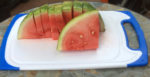
our slices ready to be wood fired!
For the watermelon, cut lengthwise in half and cut each half into individual slices about 1-1/2 to 2” thick.  Or, you can remove all the rind and grill just the watermelon meat.  Keep fire safe tongs at the ready so you can turn the watermelon slices just once as they evaporate some water and sweeten up.  DO NOT leave the grill!  This fruit requires a careful watch so stay put and you’ll have every piece cooked to perfection.


So Many Uses

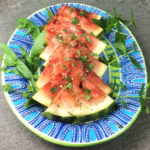
Our finished wood fired grilled watermelonYou’ll see how the watermelon darkens in color, get bits of char coloring to the skin, and is less water soluble.  That’s the perfect outcome.  Now it’s time to think about how to use your wood flavored melon.


First, you can enjoy it as is.  When I serve this naked, I just give one additional flavor such as fresh, chopped mint.   But if you’re looking for a lunch or lite dinner entrĂ©e, think salad by including some baby arugula, goat cheese and a splash of balsamic vinegar.  For a spicy version, sprinkle the wedges with red pepper flakes, a bit of granulated sugar, and lime zest.  Wood fired watermelon also works great with other summer favorites like grape and cherry tomato, pepper slices, sugar snow peas, and cucumber.  No matter how you choose to serve it, grilled watermelon with wood flavoring is going to top your list of grilled favorites.

Proving that there’s more to wood-fired cooking than just animal proteins, SmokinLicious® brings you great ideas for recipes featuring a wood-fired ingredient.  Bringing you tips, techniques, recipes and the science behind the fire and smoke.

Thursday, October 12, 2017

WOOD GRILLING AVOCADO

Add a great flavor to Avocados by grilling them!

Oh, the wonderful, healthy, creamy, flavorful avocado.  With more potassium than a banana and 18 amino acids for daily intake, you can’t go wrong with this single seed fruit.

Did you ever think to grill this fabulous fruit with a little wood to give it even more flavor?  We’ll show you just how easy it is to wood fire avocado on the gas grill using wood chunks for your smoke infusion.

Making It More Than A Grill

Regardless of the brand of gas grill you have, you can add wood chunks to the grill for wood fired flavor.  My grill has heat shields over the burners so I use that area to add one small wood chunk under the grill grate, directly on the heat shield.  No, you won’t damage your grill, as the wood combusts to ash and basically blows away.

One chunk is all it will take to get great flavor into the avocados.  I keep the burner that the wood chunk is located on set to medium as well as the burner next to that one on medium.  Since I have 4 burners, 2 are on and 2 are off.

Once the grill is to 300° F, this technique will take less than 20 minutes.

Simple Avocado Preparation

The only preparation needed for the avocados is to cut them in half and remove the seed.  The avocados are placed flesh side down on the grate only on the side with the burners off.  The heat captured within the grill will spread throughout the grilling area and cook the avocado while adding wood smoke vapor.  Note, it’s important that you don’t attempt to move the avocados for at least 10 minutes otherwise you will find the avocado flesh will stick to the grate and you’ll lose much of the fruit’s flesh.  Wait until some of the fat renders and chars making removal so simple.

Prep To Finish In Less Than 20 Minutes

In less than 20 minutes you will have wonderfully wood flavored, charred flesh avocados ready for your favorite recipes.  Think of using this fruit in smoothies, dips, on salads, as a creamy ingredient for sauces – remember, avocado can be used to substitute the amount of butter used in most recipes.  We will take some of our avocado and make a wood fired guacamole first.  Our recipe will post soon so stay tuned and don’t’ forget to send us your pics of wood fired avocado.

Thursday, October 5, 2017

PEACHES GO SMOKY FOR A FLAVORFUL GAZPACHO

Smoking/grilling with wood is a great way to enhance the flavor of peaches. Add as an ingredient in soup to add a special flavor touch on a hot summer day. Try our recipe!
One of the easiest techniques to do with fruit on a gas or charcoal grill is wood firing peaches.  Take advantage of the season with this fruit by bringing different flavors and textures for great recipe.  Why not start with my recipe for a summer gazpacho that will cool you off during the hot season.  It’s time to take advantage of the summer harvest with fresh peaches and yellow tomatoes for fabulous summer cuisine

Fresh Is Key

Peaches are one of those fruits that performs perfectly on the grill, whether you use charcoal or gas for the actual cooking process.  To start, purchase fresh, in season peaches.  Wash and pat dry.  Then pass a knife through the center until you just hit the peach pit and cut through the flesh in a circular motion.  Remember, the pit will stay in place.   Take your hands and grip each side of the peach turning your hands in opposite directions to open the peach.  This will result in the pit separating from the peach flesh of one half of the peach.  Take a spoon and gentle insert the side around the pit and loosen until the pit is released from the peach flesh.  You now have 2 equal sized peach halves.  You may do as many peaches as you like but know for the gazpacho recipe you will need at least 3-4 good sizes peaches.

Releasing Sweet Smoky Flavor

Once all the peaches are cut in half they are ready for the grill.  I am going to use my charcoal smoker for this recipe but you can easily use a gas grill with wood chunks as well.  Just see our posting on how to add wood chunks to the LP grill.

I’m going to set up an indirect method of cooking the peaches to keep them from getting too soft.  That means my hot coals will be in one half of the grill while I do the actual cooking of the peaches on the half without hot coals.  Keeping the lid on will ensure that the heat is collected in the grilling area for an even cook.

Flavor In No Time At All

I have the benefit of being able to use the SmokinLicious® charwood product which is a blend of charred and uncharred wood. It allows for a lot of smoke vapor. I place my peaches with the skin side down on the grate, keeping all the peach halves on the non-coal side of the grill.  I’ll let them cook for about 10 minutes and then rotate them so the flesh side is on the grate.  Once cook through, I will remove and place them on the skin side to cool.

Seasonal Fresh Ingredients

With the peaches wood fired and ready, it’s time to collect the other ingredients for the gazpacho:
  • 3 cups wood fired peaches
  • 3 medium yellow tomatoes, chopped
  • 1 medium sweet yellow pepper, chopped
  • 1 medium cucumber peeled and chopped – I’m using 3 mini cukes
  • ½ cup chopped sweet onion
  • 1 garlic clove, minced
  • 1/3 cup lime juice
  • 2 tablespoons rice vinegar
  • 1 tablespoon marinade for chicken
  • 1 teaspoon salt
  • 2 teaspoons sugar
  • ¼ teaspoon hot pepper sauce (optional)
  • Reserved chopped peaches, cucumber and yellow tomatoes for topping/garnish
  • You will also need a food processor or blender

Blending Your Way To Fabulous Flavor

Time to bring all the ingredients together starting with the wood fired peaches, yellow tomatoes, yellow pepper, cucumber, sweet onion and garlic.  Process all these items until thoroughly blended.  Now add the lime juice, vinegar, marinade, salt, sugar, and pepper sauce if you are including this.
Time to refrigerate for at least 4 hours or preferably overnight.  You must wait for everything to blend and make the most fabulous gazpacho ever!

With the smoky tang of the wood fired peaches meeting up with the coolness of the tomatoes and cucumber, this gazpacho has just the right amount of tang, kick, and sweet to make this a summer favorite.  Once the soup has chilled, place in serving bowls and top with chopped smoked peach, cucumber, and tomato.  All the fabulous seasonal ingredients the season can offer in one bowl!

Thursday, September 14, 2017

ARE FRUIT WOOD TREES LIKE THE APPLE “SNOW WHITE” BIT INTO?

[Fruit trees are often sprayed with pesticide to maximize the fruit yield. Spraying of chemical on the bark may not be too good for using in barbecue?]
There is a fierce debate out there about the use of fruit wood trees, specifically apple and cherry varieties, for cooking purposes.  As a Company, we frequently get the same question – “Why don’t I see Apple wood as an option to purchase?” Here’s the short answer: We do not, and will not, produce our products from orchard-based woods.  Our reason is simple – we do not believe in smoking foods over woods that have been or have the potential to be sprayed or growth enhanced with chemicals.

Let’s review a fact about trees.  All trees produce prussic acid, better known as hydrogen cyanide.  We feel that humans can use woods produced in nature when they have been left alone, unburden by the human hand in trying to manage what sometimes is the normal cyclical pattern of nature.  In the areas in which we purchase the heartwood for our cooking wood production facility, the varieties of cherry (Prunus pensylvanica L.f.) we commonly deal with are: Northern Pin Cherry, Fire Cherry, Wild Red Cherry, and Pigeon Cherry.  Of course, predominately, we bring in Wild Red Cherry.  There are many different cherry tree varieties available throughout North America.  The main difference in these woods is that our forest trees, the type we manufacture, tend to be on the sweet-tart side versus the sour-bitter.  For the most part, hydrogen cyanide is found mainly in the leaves and seeds of the cherry tree.  Black Cherry bark is also commonly used in herbal cough remedies.

The dominate opinion is that when used in small quantities, the hydrogen cyanide is a moot issue. Now let’s talk about the smoking application of wood.  Cyanogenic compounds WOULD remain a factor for our production of cooking wood.  This is because we do not allow our woods to deplete their moisture content to a level that other wood product manufacturers may (what is commonly referred to as “seasoning of the wood”).  For ideal smoking of foods, wood needs to have a moisture level preferably at ~20%.  This results in the wood smoldering rather than burning at a rapid rate.  The resulting smoke from the plant material provides for that wonderful flavor.  Because smoking is done at low temperatures for longer periods of time, the polycyclic aromatic hydrocarbons (PAH’s) found in wood molecules are not stimulated as they normally would be when cooking, say, a steak over a hot flame.  Thus, the health risk associated with PAH’s and smoked foods is not considered an issue.  The same can be said for ember cooking – using the heat of the residual coals to cook foods.

Our main concerns regarding woods used for wood fired cooking methods is to always ensure a bark-free product.  Bark does not hold moisture but rather is designed to rid the tree of wastes by absorbing them and locking them into this area.  In fact, this is the reason why bark-on woods burn so much faster than bark-free wood pieces.  This portion of the tree is responsible for temperature flare-ups, tainted smells, ‘spotty’ appearance of the food’s skin, creosote, and increase in the production of ash.  Additionally, once the temperature is increased during wood-fired cooking, heterocyclic amines, or HCAs, are created due to the reaction of the amino acids and creatine with the higher cooking temperature.

In a nutshell, a person is at greater risk of cyanide exposure in treated wood products for home construction than they are when consuming BBQ or other wood-fired foods. Knowing the source of the wood being used in the cooking application is vital to ensure that the necessary steps have been taken to prevent tree disease and pest infestation spread, as well as to ensure that the wood has not been exposed to any chemical/toxin treatments.

It is our hope, that one day soon, inspection of the wood products used by restaurants, caterers, BBQ competitors, and grocery stores who promote smoked and natural-wood fired foods, will occur as normally as food inspections.  After all, I think we all can agree that WHAT you cook the food over is just as important as what food you are cooking!