Showing posts with label wood fired. Show all posts

Tuesday, October 18, 2022

BLT SALAD GOES SMOKEY


We know smoked bacon is a favorite which is why we wanted to include a great recipe for fresh produce you may have available. This is our take on the BLT salad featuring smoked bacon, homegrown lettuce and tomatoes, as well as a homemade dressing and Naan croutons. Don’t forget to check out our technique on smoking pork belly which is super easy and fast https://www.smokinlicious.com/blog/homemade-smoked-bacon/ for the ultimate homemade smoked bacon.
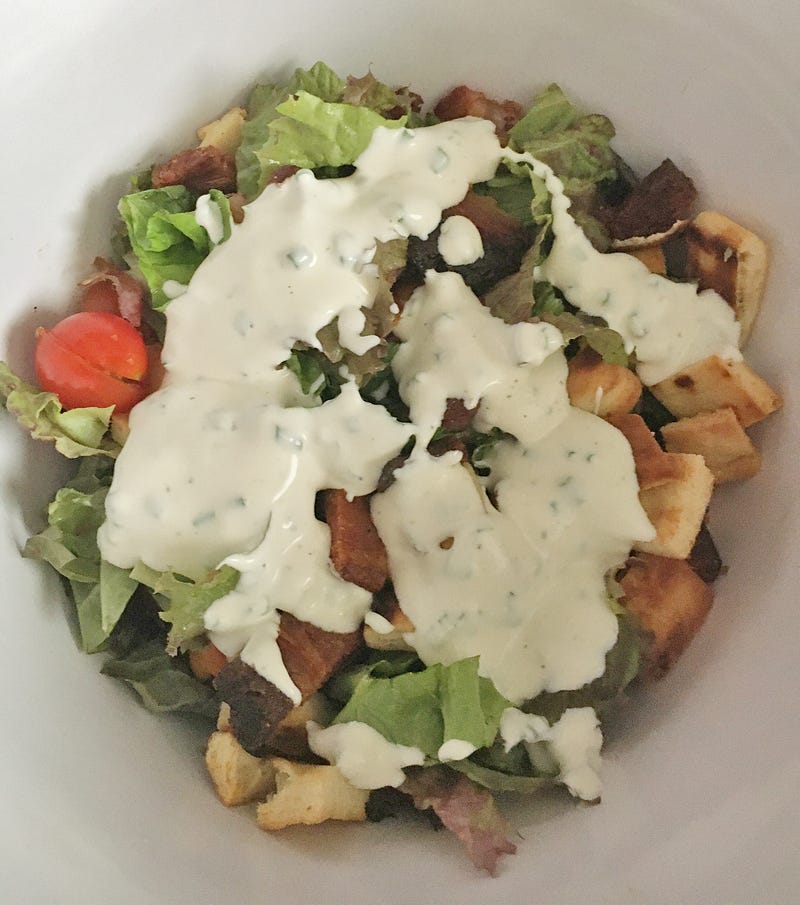
Abundant flavor in a bowl!

Dressing First

I believe a salad is only as good as the dressing you top it with. That is why homemade is so much better than any store bought, even those with limited ingredients and a claim to freshness. Make it yourself and you can guarantee freshness and flavor.

To start our dressing for the smoked BLT salad, add 4 tablespoons of sour cream to a medium size bowl. Now add 3 tablespoons of your favorite mayonnaise, a healthy grind of fresh ground pepper, a ½ teaspoon of minced garlic and ¼ cup of freshly diced chives. To dilute the dressing so it can be poured, start with 3 tablespoons of milk or cream and whisk well. Add additional milk or cream until you reach the consistency you prefer.

Crispy Bacon & Croutons

With the creamy chive dressing made, place in the refrigerator to chill while you begin the next steps for the smoked BLT salad.

If you have your smoked bacon ready, slice to the thickness you prefer. Place the slices on a sheet pan and crisp in the oven at 350°F. Timing for the bacon will depend on how crisp you want the outcome; plan 15 minutes for less crisp and 20–25 minutes for crispy.

While the bacon is cooking, take Naan and slice into small squares. Coat the cut pieces with a bit of oil and toast in the oven with the bacon until crisp as well; about 15 minutes. Remove both the croutons and bacon and allow to cool until they can be handled.

Tasting Notes: Feel free to change to any favorite bread for the croutons. Just be sure to toast in a single layer with a little oil until crunchy

Assembling & Plating the Salad

Once the dressing, Naan croutons, and crisp bacon are ready, it is time to assemble the other ingredients for our salad. This starts with our homegrown lettuce. I am using three types of lettuce: romaine, buttercrisp and red leaf. Gently tear or cut into ribbons. Add these to the center of a serving platter. Along one side of the lettuce, place your Naan croutons and cut tomatoes. For my tomatoes, I’m using homegrown cherry which only need to be sliced in half. To the other side of the lettuce, I place the smoked crispy bacon which I diced.

As you can see, the components of the Smoked BLT Salad are very simple but highly flavorful. Using fresh produce and herbs makes a big difference. I prefer to plate the salad after mixing individual portions in a bowl and tossing with dressing. Start by adding lettuce, smoked bacon, tomatoes, and croutons in a medium bowl. Add the desired dressing — usually 2–3 tablespoons is perfect- and toss with tongs. Then plate. Tangy, smokey freshness is all yours! Enjoy!


Tuesday, August 9, 2022

SWORDFISH A LA PLANCHA

Posted by Donna Grant
Read other related stories:
Fish , Plancha cooking , Seafood
[2] Comments 

Print Now!
Discover a great taste with wood chips by cooking Swordfish Al A Plancha

Discover a great taste with wood chips by cooking Swordfish A LA Plancha!

SWORDFISH A LA PLANCHA

Listen to our blog

Audio Player
00:00
00:00

Colder weather can often end your outdoor cooking but it doesn’t have to take away your desire for wood fired foods. I’m going to show you an easy method of keeping wood fired flavors going even in the coldest, snowiest weather by taking the indoor plancha to my stove top. I’ll prepare a tasty swordfish using wood chips for flavoring to the fish and finishing with a ginger-garlic butter sauce. Purchase some fresh swordfish and let’s bring authentic wood flavoring to this great cut of fish.

Swordfish A La Plancha- Preparing the Plancha

Adding wood chips to the plancha

#plancha #minutowoodchips

I love my stove top plancha pan but you can easily use a standard griddle with a heat safe pot lid.

To start, get a supply of Minuto® wood chips and prepare your plancha or griddle by first placing a ¼ cup of chips in the center of the griddle, then placing the grilling racks on the surface. Turn a medium-high heat on and place the cover on the unit to allow it to reach temperature. We want a high temperature of about 375-400° F. Once the plancha is hot, you will smell the wood chips combusting and releasing aromatic flavor. That tells you it’s time to add the fish.

Swordfish A La Plancha- Cooking & Sauce Making

making the sauce in the pan

#sauces # fishsauces

Place the fish fillets on the grill racks of your plancha griddle. Cover and allow to cook and infuse with wood flavor for 4-5 minutes on one side.

With the fish on the plancha, you can start to prepare the butter sauce that will go on the finished fish. You’ll need:

  • 3 tablespoons butter at room temperature
  • 1-1/2 cloves garlic minced
  • ¾ teaspoon grated fresh ginger
  • ¼ teaspoon crushed red pepper
  • lemon peel- ¾ teaspoon
  • 1 teaspoon olive oil
  • 1 tablespoon citrus balsamic vinegar

Place all these ingredients in a small saucepan and bring together over low heat.

After 4-5 minutes of cooking, turn the swordfish fillets and cooked for another 4 minutes. Then remove the fillets to a plate and clean out the combusted chips to a heat safe container. Place the hot plancha back on the heat but reduce it the heat to low and leave the grill racks off.

Put the fillets back on the hot surface of the plancha to sear the outside. It will only take a minute per each side. Once seared, remove to a serving plate and pour the hot butter sauce over the top. That’s it! Great wood-fired flavor done on the stove top with a hot plancha or griddle.

What’s your favorite fish to add wood flavoring to? Leave us a comment to opine and subscribe to get all our postings on techniques and recipes. Bringing innovation to wood fired cooking with recipes, techniques and the science behind the fire, smoke, and flavor. That’s SmokinLicious®.

SmokinLicious® products used in this recipe:

Wood Chips- Minuto®

For more reading related to

For more reading related on Swordfish Al A Plancha and other plancha cooking from Smokinlicious.

Related reading:

-HOT SEARED SCALLOPS!

-WOOD FIRED LOBSTER TAILS CHILI

-STUFFED SQUID COOKED ON THE PLANCHA WITH SMOKINLICIOUS®

Dr. Smoke- Swordfish Al A Plancha with wood chips adds a great smoky taste to this wonderful fish!

Dr. Smoke- Swordfish Al A Plancha with wood chips adds a great smoky taste to this wonderful fish!

  1. What great timing! Just today I was out purchasing fruitwood chips and hickory chips. (I already have mesquite chips and am an avid fan of tea smoking in a wok with tea, rice and brown sugar.
  2.  I grew up learning how to smoke eels and everything else! Your post suits me to a tee although I don’t use swordfish very often(too expensive. here….Like crayfish tails and yabbies it tends to be exported to foreign markets in much the same way as orange ruffy and abalone in New Zealand.[Economists would cite the balance of trade agreements that exist regarding trade on the international markets]

Thursday, July 28, 2022

WOOD-FIRED CLAMS CASINO

Our wood-fired clams casino on the offset grill with brick and the finished product

Have you ever noticed how many ingredients go with clams? This low fat, high protein seafood also has many beneficial minerals. They are also one of the most sustainable seafood resources.

I thought I would provide an easy wood-fired cooking method that can be done on your charcoal grill (you certainly can modify a few setup items and do this on the gas grill as well using wood) and produce the most flavorful clams casino out there.

Go find some similarly sized clams, fire up the grill, and get ready for this recipe and technique to become your favorite.

Hot Coal Grilling

Our Wood-Fired Clams Casino recipe is quite simple gather together:

    our ingredient table with everything ready for the stuffing!

  • 1 tablespoon olive oil
  • 2 oz. sliced pancetta or bacon, finely chopped
  • 1 cup finely diced red bell pepper
  • 1/3 cup chopped shallots
  • 2 large garlic cloves, minced (you can use pre-minced garlic)
  • ¼ teaspoon dried parsley
  • 1/3 cup dry white wine
  • 4 tablespoons freshly grated Parmesan
  • 2 tablespoons panko breadcrumbs
  • salt & fresh ground pepper
  • 18 medium clams, shucked, bottom shells reserved


Before starting on the casino filling, it’s important that you get the grill ready. First, you’ll want to get a chimney starter of charcoal going. I’m using SmokinLicious® charwood in place of traditional charcoal as this is a partially charred product that will also provide for some hardwood flavor infusion. Once lit, the chimney starter needs to burn down the charwood to hot coals – no flame should be visible when you dump this into the grill.

our wire mesh on the charcoal rack to retain all the small and hot pieces

For my charcoal grill, I’ve set a mesh screen at the base of my kettle grill to allow me to retain as many hot coals as possible. The screen helps to prevent small coals from falling through the charcoal area. I’ve also covered brick with heavy-duty foil to act as a heat conductor and radiator. This will help to keep a constant temperature during the actual cooking process. The brick will also separate the cooking area from the fuel area. A bit of unlit charwood is also added to the charcoal half of the grill so these bits can ignite from the hot coals and sustain the heat level more evenly.

Casino Mixture

our ingredients in the mixing bowl with cheese added

With the charwood burning in the chimney starter, I can now start on the casino filling. After adding a tablespoon of oil and cooking the pancetta or bacon in a skillet, I’ve put that aside on a paper towel lined dish and added the diced red pepper to the fat drippings in my pan. After cooking a few minutes, I had the shallots, garlic, and parsley to the same skillet and sauté until the shallots are tender and translucent, which is about 5 minutes. Add the white wine and simmer until it is almost evaporated. Remove the skillet from the heat and cool completely.

Assembling the Casinos

While the casino mixture is cooling, I prepare my clams. Here you have a couple of options depending on your skill level and time management. You can shuck the clams as normal and reserve the bottom shell with the clam, or you can steam the clams until just open, separate the top from the bottom shell, reserving the bottom shell. I loosen the clam from the shell so it’s easier to consume with the casino mixture. After the clams are readied, I take the cooled casino mixture and add the previously cooked pancetta or bacon, 2 tablespoons of grated Parmesan, and fresh pepper mixing well. I then take a tablespoon of the mixture and mound it over the clam in the shell. The finished clams are placed in a grill-proof pan.

Wood Firing Brings Depth of Flavor

Chef Bert explains the indirect cooking method.

With all my top neck clams stuffed with casino filling, I sprinkle the remaining Parmesan and the 2 tablespoons of panko bread crumbs over each clam. I am now ready to place the tray on the grill. Since I’m using a two-zone cooking method, I can safely put the lid on the grill without concern for charring these clams too far. With a steady temperature of about 300°F, these will take between 15-20 minutes. You can rotate the tray if you feel the heat level in your grill is not even or steady. For those that like a crunchy outside to the clam feel free to place these under the broiler for a few minutes. The clams pick up the wood flavor in a very balanced way, giving just hints of charry goodness with each bit. Super easy, super flavorful, and super fun to make. Take your clams to the wood fire for your next event.

The Culinary Crew wants you to know…

about the great results had from indirect cooking or the two-zone grilling technique, as referenced in this recipe blog. When it comes to this particular recipe, you will find that wood fired clams done on a charcoal grill with indirect heat and a simple brick heat conductor will add a distinctive smoky flavor twist to your clams casino. This appetizer promises to be a fan favorite for any seasonal or football party!

Now you can enjoy a video tutorial on this recipe as we collaborated with our friends at Passing It On. Get the visual step-by-step directive on making our rendition of clams casino.

Thursday, October 4, 2018

YOU ARE WHAT YOU EAT – APPLIES TO WOOD COOKING

"You are what you eatII" saying is more true today than it was years ago!
“You are what you eat” saying is truer today than it was years ago!


We’ve all heard it, likely from our mothers.  You are what you eat.  If you truly understand the meaning of the statement, you know that we extract necessary nutrients from the foods we ingest to energize and stabilize our bodies.  The nutritional content of what we eat determines the composition of our cell membranes, bone marrow, blood, and hormones.  Every day we lose cells which is why the foods we consume are so vital to our body’s health.

Like Any Other Food Choice

If you’ve been a follower of my writings then you are aware of the stress I put on recognizing the wood used to cook foods is just as important an ingredient as the cut of meat, choice of spices, quality of oil, etc.  There has been a lot of focus on the origin of food and how important it is to source locally both as a means of supporting local business and to control what you’re putting in your body. 

From our perspective, you want to know that the wood used for cooking is sourced close to the growing area.   This ensures that there is knowledge about how the wood is processed before it gets to you and it assures the freshest product.

Minimal Processing

Just as with the clean food concept which focuses on minimally processed foods and as direct from nature as possible, SmokinLicious® holds to the same approach.  Sourcing wood from forest regions (direct from nature) that are in close proximity to our manufacturing facility, provides us with the unique advantage to process into the various cooking products the hardwoods harvested that meet our strict criteria: 100% bark-free (we don’t allow any bark-on product to cross our threshold), 100% heartwood (no outer cores of the tree cross our threshold), harvested hardwood that is less than 6 months of age (ensures this is still a “green” product), chemical-free (no pesticide or growth enhancement techniques employed), and in raw state to allow us to process it into a suitable cooking wood size.

The Risks

If you love foods that are cooked with wood, then you should know a few specifics to keep you on the path to health and long life.

Hardwoods only!

  • Softwoods or coniferous woods should never be used for cooking as they have elevated sap levels and more air in their cell structure. This causes them to burn fast, produce lots of sparks, and unpleasant flavors that are not ideal for flavoring foods. These include pine, redwood, cedar, fir, spruce, hemlock, larch, cypress.

Toxicity Risks:

  • There are many known toxicities in certain species of wood with softwoods containing the highest risk. Other woods have the potential to cause sickness and in some cases death if a person’s system is already compromised. Most of the risks are associated with the cooking process rather than the ingestion of the actual wood-fired food. But know that if a balance of the wood-tar creosote is not found, then the ingestible risks of the food heighten.  One of the best means of obtaining a balance is by starting with hardwoods that are considered safe for cooking, are clean, are bark-free, and derive from the inner cores rather than outer of the wood, where more impurities lurk.

Cooking Technique Influence Risk:

  • At some point, I’m sure you’ve read about heterocyclic amines (HCAs) and polycyclic aromatic hydrocarbons (PAHs). These are the chemicals that form when meats, poultry, and fish are cooked using higher temperature methods like grilling. Why does this pose a health risk?  Because these chemicals cause changes in DNA and when you change DNA and they are metabolized by specific enzymes in the body, you can increase the risk of cancer associated with these compounds.  There is no definitive link between HCA and PAH exposure from cooked meats and cancer in humans.  There is no way to differentiate between other exposures to the chemicals from the food exposure.
HCAs are found to only be associated with meat cooked at high temperatures. While PAHs can be found in other smoked foods.  Remember, PAHs are also in cigarette smoke and fumes from car exhaust.  A recommendation is to remove any charred portions of meat, continuously turning meat over the high heat source, and avoiding direct exposure of meat to the open flame to reduce exposure.  Here’s a tip that can also reduce the risk of forming HCAs – marinate your foods for at least 10 minutes.

Thursday, May 31, 2018

WOOD FIRED GUACAMOLE

Wood fired guacamole by grilling the avocado's before you make the guacamole will excite your taste buds! Your quests will wonder how you did this simple recipe by adding only one small step!
Wood fired guacamole by grilling the avocado’s before you make the guacamole will excite your taste buds! Your quests will wonder how you did this simple recipe by adding only one small step!


The single seeded berry, fleshy fruit we know as avocado is loaded with healthy fats, 4 grams of protein, and 975 milligrams of potassium which is nearly twice as much as a banana.  With 18 of the amino acids recommend in daily consumption, you’ll want to include avocado in your diet.
We thought we would take this fruit favorite and add a flavor level for your avocado recipes by wood-firing the avocado.  This simple step will bring all the nutritional benefits of the fruit with a bold new taste.


7 Fresh Ingredients

Once you’ve wood fired your avocados on a gas or charcoal grill (see our posting on this technique), you need to gather the following ingredients:
  • 3 wood fired avocados
  • 1 finely grated garlic clove
  • 1 finely chopped Serrano or jalapeno pepper
  • ¼ of a white onion, finely chopped
  • 2 tablespoons of freshly squeezed lime juice
  • 1 tablespoon chopped cilantro
  • 1 teaspoon kosher salt
In addition to the above ingredients, you’ll need a blender or a mortar and pestle.  I prefer the mortar and pestle so I can control the level of “mash” that occurs to each ingredient.


Layering on the Flavors

First up, you need to mash up the wood fired avocado flesh.  The best guacamole has some chunky quality to it so keep this in mind when you are mashing the flesh.  Once the avocado is mashed up, add the pepper and combine that as well.  You can select the pepper based on whether you want heat or not.  If you prefer a guacamole that has no spice, then add a sweet pepper.

Once the grilled avocado and pepper are mixed, time to add the other ingredients.  First in, chopped onion followed by lime juice, cilantro and salt.  Combine everything well ensuring that any chunks are not too big for any of the ingredients.  Soon you’ll get the aroma of all the fresh ingredients and have an idea just how this is going to taste.


PREPARE TO SERVE THE WOOD FIRED GUACAMOLE!

The best part about wood fired guacamole is just how simple it is to make yet the flavors are so fresh and intense.  Select your favorite serving piece.  Once all the ingredients are combined, scrape all the contents from the mortar and place in the serving dish or bowl.  I like to top my guacamole with some smoked paprika so it has a bit of color to the top. Keep in mind, you don’t need to just use this with taco chips.  This is a great topping for a burger or grilled chicken sandwich and even works well with salad greens.  You’ll love how the wood flavor adds another dimension to this favorite food.

Thursday, May 17, 2018

WOOD-FIRED APPLES MAKE THE BEST CAKE

WOOD-FIRED APPLES MAKE THE BEST CAKE BECAUSE OF THE UNIQUE FLAVOR BROUGHT OUT BY THE SMOKING PROCESS!
Wood Fired Apple


As the second most consumed fruit in the USA, apples are loaded with antioxidant benefits and have been found to have extensive benefit to the colon due to the high level of gut bacteria present in its polyphenols.  Plus, this is a fruit that is readily available all year long making it an ideal choice for cooking.

We are taking the Gala variety and putting them over a coal fire for wood-fired flavor in our apple pie cake.  Pick your favorite variety of apple and get out the charcoal grill for this fun and simple technique and recipe.

Fire Up the Grill


Fire up the Stok grillAfter purchasing 12 apples of your choice, get the charcoal grill going, so the flames can reduce to hot coals.  That’s all needed for our apple cooking!  Any size charcoal grill will do, including the small portable grill.  I use a chimney started to lite charwood from SmokinLicious® as this is my preferred product when I do a short cook fruit or vegetable item.  The reason?  It is not fully carbonized, so it still releases plenty of flavonoids from the hardwood.  You certainly can use a standard hardwood charcoal but add a chunk or two of SmokinLicious® double filet wood chunks to be sure you get a wood flavor.

While the chimney starter is burning down to hot coals, I peel and thinly slice 12 apples.  I use a Gala variety for my recipe and a Stôk charcoal grill, equipped with an insert system.  I place my sliced apples in the insert vegetable basket for this simple method of wood firing the apples.  Just be sure to spray the basket with non-stick cooking spray to ensure the apples don’t stick.

A Cake by Name

With my hot SmokinLicious® charwood producing steady heat, my 12 Gala apples peeled and sliced thin, I’m ready to place the vegetable basket over the hot coals.  Remember, apples have a lot of water content, so they will steam initially.  The water will attract the smoke vapor and bring great color and flavor.  After approximately 10 minutes, I shake the apple slices in the basket to allow them to rotate for even cooking and color.  You’ll see the edges become bronzed as they cook.   In 20 minutes, these will be ready to go.

wood-fired apples make the best cake

Adding the Ingredients & Cook Time


After the apples are removed from the grill and cooled slightly, add a teaspoon of cinnamon and 2 teaspoons of fresh lemon juice to maintain color until baked in the oven.  Set those aside and gather together 2 cups flour, 1 cup packed light brown sugar, 1 teaspoon cinnamon and 2 sticks of cold butter cut into 8 cubes.
Our wood fired apples and dry ingredients mixed in the pan ready for baking
Start by combining 2 cups of flour, 1 cup of packed light brown sugar, and 1 teaspoon of cinnamon.  Taking one piece of cold butter at a time, add to the flour mixture, cutting each piece using either an electric hand mixer, 2 knives or a pastry cutter.  You want to have pea-size pieces of butter mixed into the flour mixture.  Press 2/3 of this mixture into a 9-inch spring form pan then add the wood-fired apple slices, spreading evenly in pan.


With the wood fired apple slices nestled in the simple cake batter of flour, brown sugar, and cinnamon, it’s time to top the apples with the remaining 1/3 flour mixture.  Be sure all areas are covered.  Set the spring form pan on the foil lined sheet pan and place in a 350°F oven for 75 minutes.  Once cooked, remove from the oven and allow to sit in the spring form pan until cool.  Just run a knife along the edge of the cake to ensure it will separate from the pan’s ring once removed.  Remove the ring when the cake has cooled then sift a ¼ cup powdered sugar on the surface of the cake.

Cake Perfection


Our finished wood fired apple pie cake nicely golden brown
After giving Gala apple slices the lick of smoke from our charwood grill, mix together flour, brown sugar and cinnamon with butter for a great cake batter, and baking everything together, the ultimate in apple pie cake is born.  With a light coating of powder sugar, the wood-fired apple slices pile high for perfection in the single bite.  More like a cobbler batter than cake, you’ll love the simplicity of the construction and the unique flavor a wood fire gives to apples.  Perfect anytime of the year, just like apples are, you’ll be the envy of your neighborhood when you fire up the grill for wood infusion to apples.  Now you must also prove that Wood-Fired Apples make the best Cake – Enjoy!

Thursday, April 12, 2018

THE HISTORY OF FIRE COOKING PART III

THE HISTORY OF FIRE COOKING PART III
In Part I, we covered scientific theories on how cooking with fire began approximately 2 million years ago.

Part II, we presented information on how our bodies developed from the introduction of cooking meat. THE HISTORY OF FIRE COOKING PART III, we delve into the early risks of cooking with fire and gender roles.


It May Not Have All Been Good

Although we’ve discussed the benefits of the discovery of fire for cooking, including the higher caloric content needed for survivability, there are other effects to fire cooking that aren’t so positive.  This is a relatively new focus in research concerning fire cooking and human evolution.

A USA study suggests that a genetic mutation may be present in modern humans that allows certain toxins, including those found in smoke, to be metabolized at a safe rate.  This genetic mutation was not found in other primates like the Neanderthals or hominins.  Breathing toxins found in smoke can increase the risk of respiratory infections, suppress one’s immune system, and even cause disruption in the reproductive system.  It is possible that by having this genetic mutation, the tolerance to smoke toxins was a needed adaption that gave early humans the ability to survive in this very toxic environment.


Closeness Brings Disease

We also know that fire allowed for not only cooking but warmth, light, and protection.  To gain the positives of fire, early humans would gather together in close proximity to one another.  A 2016 study suggests that with the advancement of fire’s uses, people remained in huddled groups for long periods of time, suffered persistent coughing resulting from the smoke toxins, and subsequently damaged the lungs.  This may be what spurred the spread of tuberculosis which some scientists believe emerged 70,000 years ago.  In fact, most scientists believe that fire was regularly used around 400,000 years ago, thus supporting the advent of tuberculosis.

Other scientists believe the use of controlled fire introduced additional airborne diseases.  Plus, many opine that the early days of exposure to inhaling smoke from open fires stimulated our discovery of smoking tobacco.  Without question, these believers feel that climate changes resulted from the ongoing burning of carbon.  For them, biological and environmental changes co-mingle.


Gender Identities

It is amazing that in those early years of fire discovery the establishment of gender roles occurred and seems to have held in general theory. As tools developed and cooking with fire expanded, men did the hunting and women stayed with the fire, maintaining it and cooking previously hunted and foraged foods on/over it.

Although today both males and females hunt, the number of men still outweighs the woman.  Despite the number of male chefs outnumbering the women, women still dominate as the primary cook in the home.  Yet, males still barbecue and grill in a greater number.

It seems clear that there are other influences on the roles men and women play when it comes to fire cooking around the world.  Finally, in Part IV of our series, we’ll explore the variations in method and technique from around the world. Finally, we hope you enjoyed THE HISTORY OF FIRE COOKING PART III blog.


Thursday, April 5, 2018

THE HISTORY OF FIRE COOKING PART II

The history of fire cooking part II
In Part I, we covered the scientific theories on how cooking with fire began, including the scientific documentation that puts this method’s discovery approximately 2 million years ago.  In The history of fire cooking part II, we will present additional information on how our bodies developed from the introduction of cooking meat as well as the evolution of the wood fire to the oven.


A Change in Anatomy

Our ancestors were chimp-like creatures and thought to be the most advanced animals on earth.  These creatures had long arms, short legs, hand-like feet, large mouths and powerful jaws.  Covered in fur, they slept in the trees. That is, until they discovered fire and learned to cook.

Once fire cooking was founded, these ape-like creatures became erect, their brains enlarged, and their jaws became smaller.  Why?   Because cooked foods provide a higher caloric value.

Research has shown that weight loss is guaranteed to people who consume raw-food diets only.  In fact, the more raw food consumed, the more weight loss.  The only problem with this diet is it takes a lot of raw food to generate a caloric level to sustain an active animal.  Our primate ancestors had to graze all day to generate enough calories to keep going leaving time for nothing else.

With the discovery of fire and all its benefits, ape-men emerged.  Originally covered in fur, a few thousand years following fire’s discovery, the fur disappeared.  As a result, this helped to improve hunting skills as the weight of fur made ape-men faster.  Also with the discovery of fire, these creatures had no need to escape to the trees at night as fire provided protection from predators.  Without the climbing, long legs developed and feet that looked less like hands.


The Start of the Family Dynamic

Once animals were trapped and cooked within flames of forest fire and these creatures sampled cooked vegetation and meat; that changed everything.  They began to develop skills at designing knives for hunting.  This in turn developed some level of social skills and brain development, as the brain was being fed more nutrients.  Flint was discovered and used to produce sparks when rubbed against rocks, allowing for control of fire.

Hunting became a daily event.  The first gender structure was designed with males hunting and females cooking.  It was cooking that forced early humans to live by cooperation.  Both males and females relied on each other.  This was the start of family, and more socialized and calmer tempers.  With regular ingestion of cooked foods, the brain began to grow since cooked food takes less energy to digest, more energy defaulted to brain development.  Learning to cook gave these developing humans more time which allowed for more food discoveries and time management.


The Oven

Once fire was discovered and harnessed for the betterment of life, it was a slow transition to bring cooking from the outdoors into the indoors.  First, as mentioned in Part I of our series, it transitioned into cave dwellings.    We know that in ancient times, the period of 60,000BC to 650AD, ancient Egyptians, Jews, and Romans all used some form of stone or brick oven cooking, fired with wood, to produce breads.  In fact, that early design remains very much like the pizza/bread ovens of today.

Beehive-shaped brick ovens came about in Colonial America, the period of 1492 to 1763, and was the advent of learning to control the amount of wood to ash to regulate temperature.  If you’ve ever heard of or used “the hand test” to measure temperature of a grill or outdoor cooking fire, then you know how Colonial Americans tested their ovens.  Hold your hand about 5-inches from the cooking surface.


The number of seconds you can hold your hand there equals a temperature level:


High (450° to 550°F): 2 to 4 seconds
Medium (350° to 450°F): 5 to 7 seconds
Low (250° to 350°F): 8 to 10 seconds

Colonial Americans would add more wood to increase temperature or open the door to reduce it.
The invention of cast iron stoves began to replace wood hearth cooking in the 1700’s.  In 1795, Count Rumford invented a version of the cast iron stove that was different from earlier versions in that it had a single fire source that could be regulated individually for different pots being used at the same time.  Additionally, it could heat the entire room.  Unfortunately, it was extremely large making it difficult for most kitchens to accommodate it.

With the discovery of electricity, man continued to find new uses for this source of energy.  In fact, one of the keys was to incorporate it into the home and the electric stove was key to making home life easier.  In 1892, an entire meal’s preparation was demonstrated at the Ottawa Windsor Hotel in Canada, paving the way for sale to future homes.


Continued Discovery in The History of Fire Cooking

These early discoveries are what formed our continued thirst for finding the best methods of cooking in the fastest yet most flavor means possible, while feeding our brains to keep us developing.  Charcoal grills, brick and clay pizza ovens, gas grills, infrared grills, campfires were all shaped by the very first cooking event, even if the first event was by nature’s hand alone..  In conclusion, we hope you enjoyed the The History of Fire Cooking Part II. Finally, stay tuned for part III.

Thursday, March 1, 2018

THE HISTORY OF FIRE COOKING PART I

The history of fire cooking part I

For thousands of years, it was the only way to cook.  Many believe that this discovery separated man from the other animals.  Fire.

Estimated to have been discovered some 2 million years ago, the discovery of fire and more importantly, the discovery of how to tame fire, resulted in man’s brain development, value of food, changes in our body, and social structure.  It gave us survivability.  It extended our life by improving daily calories and nutritional needs by allowing us to cook poisonous plants and meats.

So how did fire cooking get discovered?  That is the million dollar question.  Here are some of the hypotheses out there regarding the discovery of fire for cooking:

Nature Provides Ignition

There are some scientists who believe that fire cooking was found by accident.  A lightning strike or grass fires that sprung up due to the excessive dry conditions exposed to the hot sun.  Many don’t feel man did anything to “discover” fire other than observe the characteristics of fire: it produces abundant heat, light, and when it traps an animal within its flames, it produced a more tender meat, easier to digest food source, and more pleasing aroma to the meat.

Tool Construction

There are others who believe that early humans realized the importance of tools.  By sharpening stones to produce spears, cutting tools, etc., these early beings observed spark.  Either through intention or perhaps with Mother Nature’s assistance, these sparks caught twigs, brush, fruit, and/or grains on fire.  Remember, early human life did not involve a developed brain.  A discovery of fire, however, would help advance not only our brains, but our bodies into the erect beings we are today. 

The Earliest Cave Cooking

In South Africa’s Northern Cape province, a dwelling known as Wonderwerk Cave, contains the earliest evidence that our ancestors and apelike ancestors were using fire.  Compacted dirt showed evidence of ashes, carbonized leaf and twig fragments, and burnt bits of animal bones.  Scientists were then able to analyze this material and determine that the fragments were heated between 750 and 1300°F, which is the heat level of a small fire made of twigs and grasses.

If indeed our earlier species learned to harness fire for cooking, this would account for the advancement of our brains and our ability to become erect beings walking on two legs.  Cooking on fire allowed for easier chewing and digestion and produced extra calories to fuel our brains. Fire also warded off nighttime predators, allowing for sleep on the ground or in caves rather than in the trees.

It’s All About Energy

Raw food diets have been popularized as a method of losing weight and of being healthier.  However, only a fraction of the calories in raw starch and protein are absorbed by the body via the small intestine.  As a result, the remainder passes into the large bowel, where it is broken down by the organ’s high population of microbes, which consume the majority for themselves.  However, cooked food is mostly digested by the time it enters the colon. For the same amount of calories ingested, the body gets roughly 30 percent more energy from cooked oat, wheat or potato starch as compared to raw, and as much as 78 percent from the protein in an egg.  In experiments, animals given cooked food gain more weight than animals fed the same amount of raw food.

Cooking breaks down collagen (connective tissue in meat) & softens the plants’ cell walls to release their storage of starch & fat.  The calories to fuel the bigger brains of successive species of hominids came at the expense of the energy-intensive tissue in the gut, which was shrinking at the same time.  If you look at early imagery of apes, you’ll see how we morphed into narrow-waisted Homo sapiens.

Coming up in The History of Fire Cooking: Part II, learn more about why cooking foods by fire made us who we are today.  In conclusion, did we provide you with new information you didn’t know?  Additionally, leave us a comment and subscribe as we bring recipes, tips, techniques, and the science behind the fire and smoke.
 

Thursday, February 22, 2018

SMOKINLICIOUS® IS AN F2C

Learn why selecting an F2C level Company may save you from unwarranted stress

In today’s age of selling products and services, there are acronyms that are common to marketing and sales strategies.  First, there is B2B which refers to business to business relationships.  This means that a product or a service is sold from one business to another.  An example of each would be windshield wiper fluid being sold to gas stations and attorney services to large corporations.


B2C is shorthand for business to consumer.  This is selling a product or service directly to a customer that is not necessarily a business.


Now, you may automatically assume that SmokinLicious® would fall under both these sales types, and you would be right.  But there is another acronym you likely aren’t familiar with: F2C.


Making a Better Connection


F2C refers to factory to consumer or more specifically, manufacturer to consumer.  There are many reasons why this is a plus to both businesses and consumers doing business with a specific manufacturer.  Let’s examine the major advantages from the perspective of doing business with SmokinLicious®.

Advantage #1 Details
 
As the manufacturer of all the products sold under the brand SmokinLicious®, we can provide the specifics on where the hardwood comes from, the age of the wood, the handling of the product, the treatment the wood is exposed to, and the details on packaging.  You don’t have to wait on answers to your product questions like with a supplier who is simply a re-seller of the wood.  We give answers immediately!


Advantage #2 Intimate Knowledge
 

When you are committed to manufacturing a specific product, you tend to know that product thoroughly.  For SmokinLicious®, that equates to us knowing not only about wood fired cooking techniques like hot smoking, ember cooking, and cold smoking but we know the science behind hardwood; molecular biology of the wood as well as for combustion.  We know why smoke gives flavor and how to respect and control it.


Advantage #3 Availability
 

We aren’t simply selling a product to move it out of inventory.  As a manufacturer, we are committed to answering questions whether on email, via phone, or social media platforms.  No, we don’t operate the phones 24/7.  But we do get back to anyone who contacts us, usually within 24 hours.  We are available to everyone!


Advantage #4 Passion
 

Sometimes I feel the word “passion” is overused but that word really does describe the people who make up the SmokinLicious® Team.  We are passionate about cooking with fire and the smoke it produces.  We simply love to offer our perspective on cooking with wood.  Remember, just because someone sells a specific product doesn’t mean it was a dream of theirs.  It simply may be the “thing” to do with no real commitment.  Who wants to commit to that type of supplier!


Advantage #5 Skilled
 

We have a test kitchen/patio and we use it – all the time!  That’s the only way you can know all the different applications for the product we manufacture and sell.  We possess the skills to guide you on what might be causing bitter flavors, poor color, equipment failures, and so much more.  Plus, we offer daily postings on recipes, tips, techniques, and the science behind cooking with fire and smoke.


Advantage #6 Global
 

We can be everywhere because we know our commodity and the regulations that relate to our products.  We don’t cut corners because we are as concerned about our environment and forests as the agricultural agencies around the world.  You won’t ever need to worry about having your supply cut off because a regulation or law wasn’t followed.  


Advantage #7 Exclusivity
 

Don’t you want assurance that it’s clean?  We only sell hardwoods for cooking and culinary use!  That’s it!  We don’t take waste product from some other wood process and sell it off under a new label or brand.  We don’t buy woods from anyone who can’t document on paper where the wood is from and if exposure to chemicals is possible.  SmokinLicious® is exclusively a culinary wood product!


These are just some of the advantages to working directly with and purchasing directly from a manufacturer, or F2C.   When you want assurances that any question you have can be answered, that any product need can be met, that your equipment will be protected, then seek a direct manufacturer first and eliminate a middle man that may only be in it for dollars and cents.  Or one day you could simply find they’re no longer in business or they no longer can ship product throughout North America or other continents, leaving your Company with a big problem.